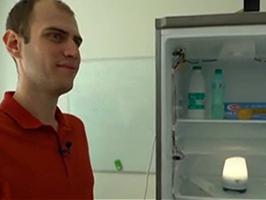
The Smart Fridge, Invention of Romanian Students
October 2022 – The Smart Fridge presented on Antena 3 CNN

October 2022 – The Smart Fridge presented on Antena 3 CNN
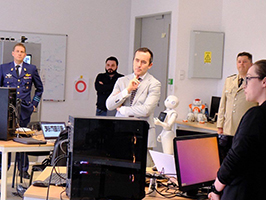
Visit of the NATO delegation to the AI-MAS Laboratory
12 October 2022
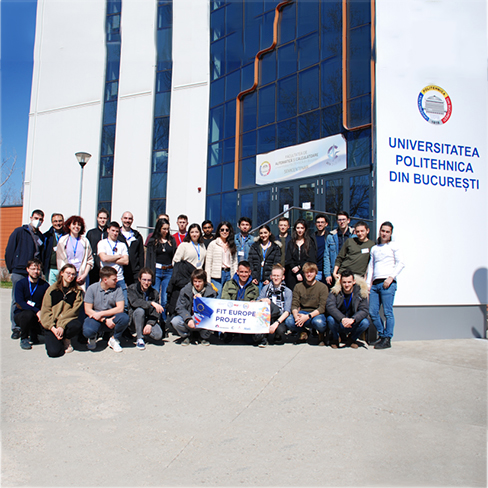
Visit of the participants in the fourth FIT-Europe seminar to the AI-MAS Laboratory
23 March 2022
In healthcare, the cost of treating brain disorders accounts for a significant percentage of total treatment costs. In Europe, the budget for treating brain disorders alone far surpasses the combined budget for other diseases. Utilising cutting-edge AI, the EU-funded ALAMEDA project could greatly reduce the cost of treating these conditions by enabling personalised care and improved treatments for major brain disorders. The goal is to demonstrate AI-enabled prediction, prevention and intervention, making the treatment of disorders such as Parkinson’s, multiple sclerosis and strokes more affordable and easing the burden on healthcare systems across Europe.
ALAMEDA is a truly pan-European project and brings together a highly skilled and complementary consortium of 15 expert organisations from across 8 countries. University Politehnica of Bucharest is coordinating the WP3.
The project has received funding from the European Union’s Horizon 2020 research and innovation programme under grant agreement No. 101017558.
Duration: 2021-2023
In hypermedia-driven Multi-Agent Systems (HyperAgents) the web and its architecture act like a global environment in which different types of agents (whether human or software) perform interactions and compose the functionality of web-enabled things to achieve their goals.
The main objective of this project is the development of a web-based framework facilitating context-aware search and discovery of web-enabled things in hypermedia driven environments. The requirement is to facilitate the detection and understanding of shared context between a producer and a consumer to enable corresponding discovery of and access to relevant web resources to agents operating in the web environment.
To achieve its objective the project aims to:
1) Develop a web-based platform that can expressively model relevant context information of web things and enable a semantic-query and complex-event processing based mechanism to define and detect situations of shared context between web things and agents;
2) Develop a web-based APIs that take the detection of a shared context as input and are able to facilitate the creation of authorization elements that integrate into existing access control and search technologies for web things.
Duration: 2021-2023